Tumors Treated

Proton therapy is effective in treating certain types of cancers as well as some non-cancerous tumors and arteriovenous malformations. The tumors listed below represent those that often benefit from proton therapy. Additional tumors may also be treated with proton therapy. Only a doctor can help you determine the best treatment approach for you.

Brain Tumors

A number of tumors are classified as brain cancer whether they originate in the brain or have spread to the brain from cancers in other parts of the body. Although brain cancer can be treated with surgery, chemotherapy and standard X-ray radiation, proton therapy can be particularly beneficial. The ability of protons to deposit more of the energy in the tumor and cause far less damage to surrounding healthy tissue than standard radiation therapy makes proton therapy an ideal treatment option.

The brain tumors most appropriate for proton therapy include:

  • Low grade gliomas
  • Grade III gliomas (anaplastic astrocytomas)
  • Meningiomas
  • Ependymomas
  • Medulloblastomas
  • Pineoblastomas
  • Supratentorial PNET
  • Germ cell tumors

Arteriovenous malformations (AVMs) of the brain also can also be treated using protons.

Compared to other forms of radiation therapy, proton therapy results in less radiation to normal brain tissue so patients experience fewer side effects. The extra dose to healthy tissue from X-ray radiation therapy can be as much as 75,000 - 450,000 dental X-rays.

Download a short guide to discussing brain tumor treatment options with your doctor.

Head and Neck Tumors

Proton therapy can substantially reduce damage to tissue and organs near these tumors, such as eyes, optic nerves and the salivary glands. Proton therapy also may result in a lower risk of side effects, such as blindness, dry eye and dry mouth.1 Head and neck tumors treated with protons include:

  • Nasopharynx (back of the nose where it meets the throat)
  • Nasal (nose) cavity
  • Paranasal sinuses (sinuses in the face)
  • Oropharynx (area of the throat at the back of the mouth), including the tonsils and base of tongue

Download a short guide to discussing cancer treatment options with your doctor.

Base of Skull Tumors

These tumors include chordomas and chondrosarcomas. Proton therapy can be particularly appropriate for these tumors because of their location near the brain stem or spinal cord, or in or near central nervous system tissue. The location of these tumors often limits the dose of radiation that can be delivered with standard X-ray radiation treatments, and can also make surgical removal difficult.

Because base of skull tumors are found at a shallow depth, proton therapy is often able to deliver a high dose of radiation precisely to the tumor without affecting tissues of the brain and spinal cord.2 More radiation to the tumor is important to provide the greatest chance for completely destroying the tumor.

Download a short guide to discussing cancer treatment options with your doctor.

Prostate Cancer

Prostate cancer is treated with surgery, standard X-ray radiation therapy, and frequently the placement of radioactive seeds (brachytherapy). In some cases, "watchful waiting" is chosen where the patient is regularly tested and no therapy is given unless the cancer progresses.

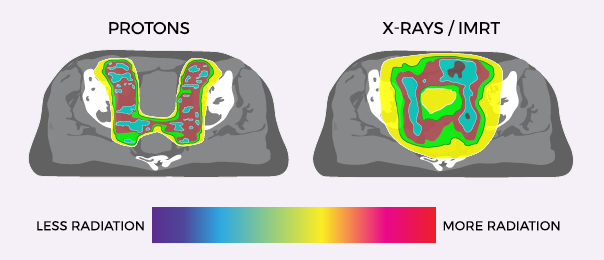
Proton therapy offers an excellent treatment option for prostate cancer. The ability of radiation treatment to control prostate cancer depends on the total dose of radiation delivered. Damage to the bladder and rectum, which are in close proximity to the prostate,  can limit the dose of radiation that a patient can receive. With protons, a higher dose can be delivered to the tumor site which can result in better tumor control, while largely sparing the bladder and rectum from radiation damage.3 Studies comparing protons to X-ray therapy have reported that protons are at least as effective but have fewer and less severe side effects.4

Download a short guide to discussing prostate cancer treatment options with your doctor.

Pediatric Tumors

Proton therapy is generally preferred for treating solid tumors in children, where great emphasis is placed on reducing any irradiation of normal tissues to prevent serious complications and reduce the chance of secondary tumors. Research has shown that proton therapy can significantly reduce the risk of developmental and growth delays and abnormalities, reductions in IQ, and other complications often occurring with standard X-ray radiation. Proton therapy also can reduce the risk of the tumor returning or of cancers occurring much later at other sites in the body.1 This is especially important in treating cancers in children, whose bodies are still growing and have a high chance of developing secondary tumors when they get older. Studies that have been done on the use of protons for pediatric tumors show excellent results in controlling tumors, reducing damage to healthy tissue and causing fewer short- and long-term side effects.5,6 

Download a short guide to discussing pediatric tumor treatment options with your doctor.

Tumors Near the Spine

Treatment for tumors near the spine can be challenging. Completely removing these tumors by surgery is generally impossible because of their location in or near the spine, spinal cord or major nerves. In treating tumors with radiation close to the spine, it is particularly important to limit the amount of radiation exposed to the surrounding healthy tissue to avoid serious, lasting side effects. Proton therapy is able to focus the radiation dose to the tumor while the dose to nearby critical structures is kept at tolerable levels, limiting unwanted damage.2

Download a short guide to discussing cancer treatment options with your doctor.

Melanoma of the Eye

These tumors are the most common type of eye tumors and historically were treated by completely removing the eye. Protons have been used since the mid-1970s to treat melanoma of the eye without having to remove the eye or damage the cornea, lens, retina, fovea or optic nerve. Studies report control rates for patients treated with protons of greater than 95%, with long-term survival equal to that of patients who have had their eye removed.7 Furthermore, most patients in these studies have retained useful vision in their treated eye.8 Protons have been shown to be effective with large, medium and small tumors.9

Download a short guide to discussing cancer treatment options with your doctor.

Lung Tumors

Several proton centers are studying using proton therapy as an alternative for patients who are not candidates for surgical treatment of non-small-cell lung cancer and/or who might also be treated with X-ray radiation therapy. Preliminary results suggest that protons can provide local tumor control and minimize damage to the lung and heart.10

Download a short guide to discussing cancer treatment options with your doctor.

Arteriovenous Malformations (AVMs)

AVMs are an abnormal, tangled web of arteries and veins that can occur in the brain, brainstem or spinal cord. While there are several options for treating small AVMs, irregularly shaped and larger ones may be treated effectively with protons.11,12 Protons can be combined with other treatments (e.g., microsurgery and embolization) yielding favorable results.13

Download a short guide to discussing cancer treatment options with your doctor.

Footnotes: 
  1. Metz J. Reduced normal tissue toxicity with proton therapy. OncoLink 6.29.2006. Available at : http://www.oncolink.org/custom_tags/print_article.cfm?Page=2&id=211&Sect.... Accessed April 19, 2010.
  2. Rutz HP, Weber DC, Sugahara S. Extracranial chordoma: outcome in patients treated with function-preserving surgery followed by spot-scanning photon beam irradiation. Int.J. Radiat. Oncol. Biol. Phys. 2007;67(2): 512-520.
  3. Vargas C, Fryer A, Mahajan C, et al. Dose-volume comparison of proton therapy and intensity-modulated radiotherapy for prostate cancer. Int. J. Radiat. Oncol. Biol. Phys. 2008;70(3):744-51.
  4. Slater, J.D.; Rossi, C.J. Jr.; Yonemoto, L.T.; et al. Proton therapy for prostate cancer: The initial Loma Linda University experience. Int. J. Radiat. Oncol. Biol. Phys. 2004, 59 (2), 348-352.
  5. MacDonald SM, DeLaney TF, Loeffler JS. Proton Beam Radiation Therapy. Cancer Investigation.2006;(24):199-208.
  6. Miralbell R, Lomax A, Cella l, Schneider U. Potential reduction of the incidence of radiation-induced second cancers by using proton beams in the treatment of pediatric tumors. Int. J. Radiat. Oncol. Biol. Phys. 2002;54(3):824-829.
  7. Gragoudas, E.S.; Li, W.; Goitein, M.; et al. Evidence-based estimates of outcome in patients irradiated for intraocular melanoma.
  8. Yock T. OncoLink Web site http://www.oncolink.com/conferences/article.cfm?c=3&s=51&ss=272&id=1753 2008. Accessed April 1, 2009. 
  9. Munzenrider JE, Gragoudas E, Seddon JM, et al. Conservative treatment of uveal melanoma: probability of eye retention after proton treatment. Int. J. Radiat. Oncol. Biol. Phys. 1988;15 (3):553-8.
  10. Chang JY. et al. Significant reduction of normal tissue dose by proton radiotherapy compared with three-dimensional conformal or intensity-modulated radiation therapy in Stage I or Stage III non-small-cell lung cancer. Int. J. Radiat. Oncol. Biol. Phys. 2006, 65 (4), 1087-96.
  11. Vernimmen FJ. http://www.oncolink.org/conferences/article.cfm?c=3&s=51&ss=272&id=1754. Accessed April 19, 2010.
  12. Silander H; et al. Acta. Neurol. Scand. 2004;109(2):85-90.
  13. Sinclair J, Marks MP, Levy RP, et al. Neurosurgery. Visual field preservation after curative multi-modality treatment of occipital lobe arteriovenous malformations. 2005 Oct;57(4):655-67.